
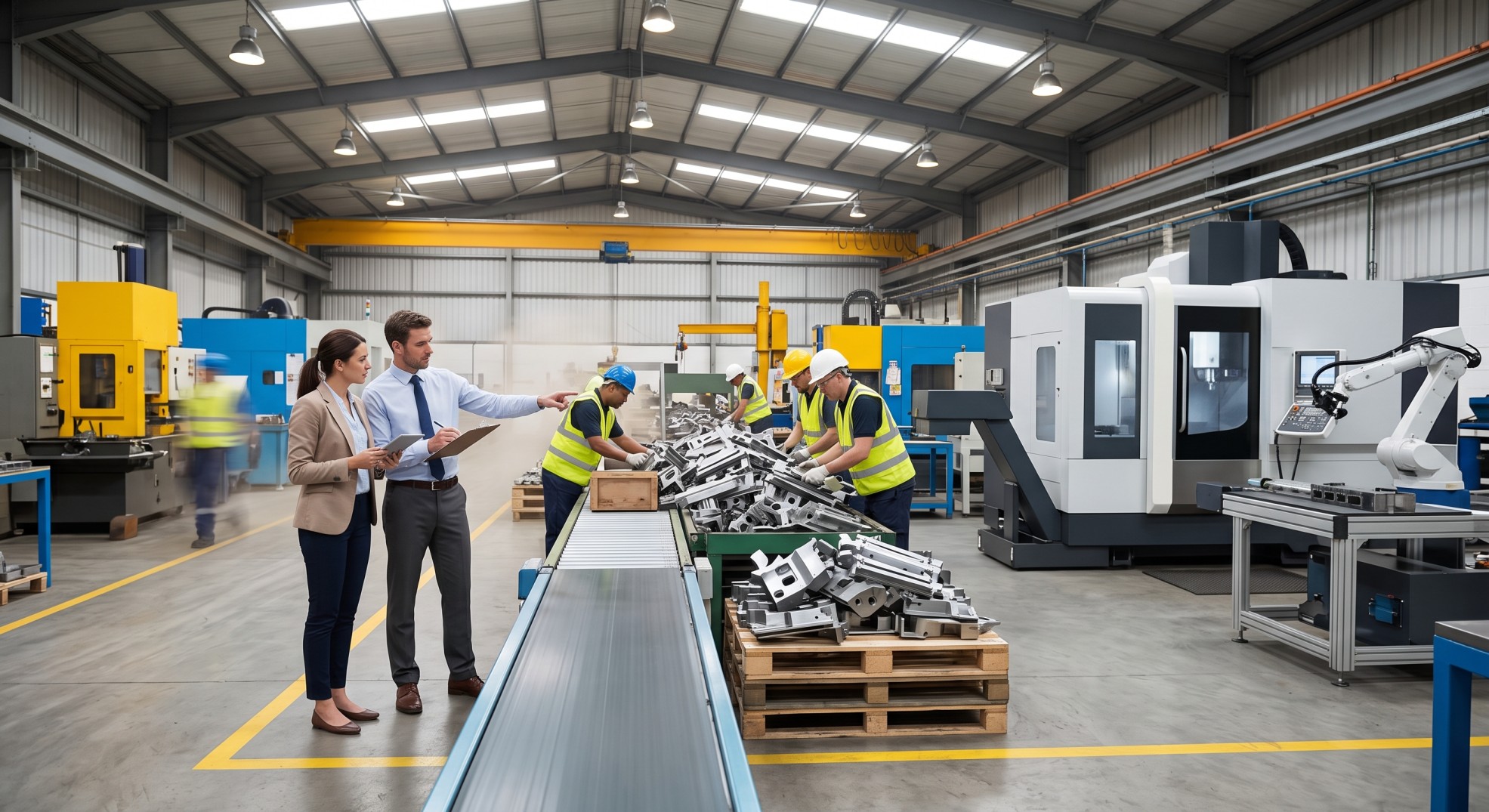
New equipment only increases output if the constraint you're trying to solve is actually a capacity limit in that machine or line. Many manufacturers invest in equipment before diagnosing where their process truly breaks down, which means the real bottleneck—often labor, scheduling, quality checks, or material flow—goes unaddressed while capital sits underused.
A production line is only as fast as its slowest point. That sounds obvious on paper, but on the shop floor, it's easy to miss. When output stalls or margins tighten, the instinctive response is often to look at the machines: buy a faster one, add a second line, automate a manual step. New equipment feels like progress. It's visible, it's measurable, and it signals investment in the future.
But equipment purchases solve equipment problems. If the actual constraint sits somewhere else—in how jobs are scheduled, how quality is checked, or how materials move between stations—a new machine won't touch it. It will simply add cost while the real bottleneck continues limiting your output exactly as before.
Understanding where your process actually breaks down, before signing a purchase order, can save significant time, money, and the disappointment of underutilized equipment sitting idle on the floor.
What is a manufacturing bottleneck?
A manufacturing bottleneck is the point in your production process where capacity is most limited, and it determines the maximum throughput of your entire operation—regardless of how efficient every other stage happens to be. You can have five stages running at peak performance, but if the sixth stage can only process half as much, your total output is capped at that sixth stage's rate.
Bottlenecks show up in different forms. Common examples include:
- A single machine that processes slower than the stages feeding into it
- Labor constraints, such as a specialized task that only a few trained employees can perform
- Quality control delays, where inspection or rework backs up finished goods
- Material supply interruptions, where upstream stages sit idle waiting on inputs
The bottleneck isn't always where it appears to be. A machine that looks slow might actually be starved for materials from an upstream step. A labor-intensive process might look like an equipment problem because nobody has measured how long each stage actually takes. This is precisely why diagnosis has to come before investment.
Why do equipment investments often fail to increase output?
Equipment investments often fail to increase output because businesses purchase machinery based on where they assume the constraint lives, rather than where it actually lives. If the bottleneck isn't in equipment capacity, adding more equipment capacity elsewhere in the line won't move the needle on total throughput.
The result is a familiar and costly pattern: new machinery arrives, gets installed, and runs below its capability because it's now waiting on the same upstream or downstream constraint that limited the old setup. Capital gets tied up, depreciation begins, and the underlying issue—the one that motivated the purchase in the first place—is still there. Meanwhile, the business has spent resources that could have gone toward addressing the actual constraint, or toward something with a clearer return.
How do you identify your manufacturing bottleneck?
Identifying a manufacturing bottleneck starts with mapping the entire production process, from raw materials to finished goods, and observing where work slows down or accumulates rather than assuming it based on intuition. A few practical steps make this diagnosis possible:
Map your entire production process. Lay out every stage from raw material intake to finished product, including handoffs between departments or shifts. Bottlenecks frequently live in these handoffs, not within a single station.
Measure cycle times at each stage. Track how long each step actually takes under real operating conditions. The stage with the longest cycle time relative to demand is typically your constraint.
Track where jobs queue up. Look for the physical evidence: piles of work-in-progress inventory, machines sitting idle waiting on inputs, or a consistent backlog forming at one particular station. Queues tell you where capacity is genuinely limited.
Interview production staff. The people running the line every day often know exactly where delays happen, even if that knowledge has never been documented or shared with leadership. Their firsthand observations can shortcut weeks of data collection.
Taken together, these steps replace assumption with evidence—and evidence is what should drive a capital decision of this size.
What role does operational analysis play in finding the real constraint?
Operational analysis plays a central role in finding the real constraint because bottlenecks are frequently non-obvious, hiding in scheduling practices, quality-check procedures, or material flow rather than in an easily identified machine. A professional assessment brings a structured, outside perspective to a floor that internal teams see every day and may no longer see clearly.
ID2Solve's Operations Advisory practice works alongside manufacturers to examine exactly these questions—mapping workflows, measuring where capacity is genuinely constrained, and identifying whether the limiting factor is equipment, labor, process design, or something further upstream. For situations where a single, well-defined question needs a fast answer before a larger investment decision, an Advisory Sprint can bring senior attention to that specific bottleneck in less than 30 days. Understanding your true constraint is the first step before any capital investment decision gets made—not an afterthought once the equipment is already on order.
How do you decide whether new equipment is the right investment?
Deciding whether new equipment is the right investment starts with confirming the bottleneck's true nature: whether it requires additional equipment capacity, a redesigned process, or a change in how work is scheduled and staffed. Not every constraint calls for capital spending.
Before purchasing new machinery, it's worth evaluating lower-cost alternatives such as process optimization, rebalancing workloads across shifts, or adjusting how materials are staged and delivered to the constrained stage. In many cases, these changes recover a meaningful share of lost capacity at a fraction of the cost of new equipment.
When equipment genuinely is the answer—because the diagnosis confirms a real capacity ceiling at that stage—the investment decision becomes far more confident. You're no longer buying based on a guess about where the problem lives; you're buying to address a constraint you've measured and verified. That distinction is what separates capital spent well from capital spent hopefully.
Diagnose before you invest
Before committing capital to new equipment, it pays to invest time in understanding your manufacturing bottleneck. Accurate diagnosis prevents wasted spending, protects margin, and puts every future investment decision on firmer ground. The businesses that get this right treat equipment purchases as the conclusion of an analysis, not the starting point of one.
For detailed guidance on evaluating your operations and identifying where your production process is genuinely constrained, visit www.ID2Solve.com to explore how ID2Solve Management Consultants can help your business identify and address its real constraints.
Frequently Asked Questions
How do I know if my problem is really a bottleneck and not something else?
A true bottleneck shows a consistent pattern: work piles up before that stage, and the stages after it sit relatively idle waiting for output. If delays move around unpredictably between different stations, the issue may be scheduling or material flow rather than a fixed capacity constraint at one point.
Is a bottleneck always a machine or piece of equipment?
No. Bottlenecks can just as easily be a labor constraint, a quality-control step, a scheduling practice, or a material-supply issue. Equipment is only one of several possible sources, which is why diagnosis matters before deciding on a fix.
How long does it typically take to identify a manufacturing bottleneck?
This depends on the complexity of the process and how much data already exists on cycle times and queues. A focused review of a specific line or issue can often be completed within a few weeks, especially when staff input is included alongside process mapping.
What are the risks of skipping diagnosis and buying equipment anyway?
The main risks are wasted capital, underutilized machinery, and a bottleneck that persists despite the investment. The business ends up carrying the cost of new equipment while the original throughput problem—and its effect on margin and delivery—remains unresolved.
Can process changes fix a bottleneck without buying new equipment?
Often, yes. Rebalancing workloads, adjusting scheduling, improving material staging, or redesigning a quality-check step can recover meaningful capacity without capital spending. These options are typically worth evaluating before deciding equipment is the only path forward.
0 Comentarios