
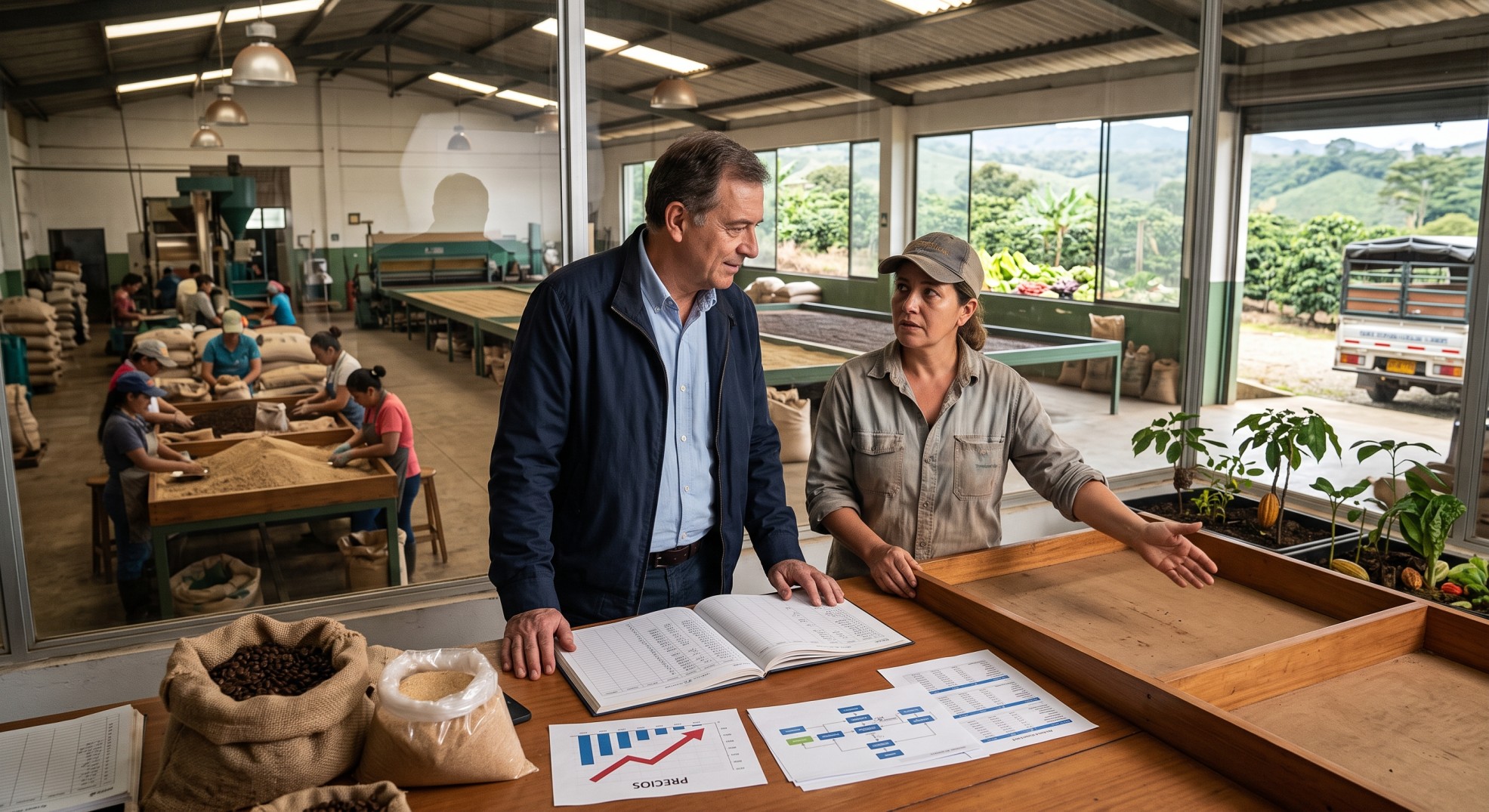
Global oversupply, a stronger dollar, and shifting buyer sourcing have pushed coffee and sugar prices down, compressing margins for Latin American producers. Family-owned and mid-sized operations face the sharpest pressure because they have less room to absorb losses. The producers who respond with diversification, quality positioning, and stronger buyer relationships will be better positioned to protect their businesses through this cycle.
Coffee and sugar have always moved in cycles. Prices climb when supply tightens, then fall when harvests recover and new growing regions come online. But for the family-owned farms and mid-sized processors that make up much of Latin America's agricultural export base, this current downturn carries a familiar sting with a modern twist: thinner margins arriving at the same time input costs, financing terms, and buyer expectations have all grown more demanding.
For a producer managing three or four generations of accumulated land, equipment, and relationships, a prolonged price decline isn't an abstract market statistic. It's a direct threat to cash flow, reinvestment capacity, and sometimes the continuity of the business itself. Understanding why prices have fallen — and what a producer can actually do about it — matters more than watching a market number move on a screen.
Why are coffee and sugar prices falling right now?
Several forces are converging at once, and few of them are within an individual producer's control.
Global oversupply is the headline driver. When major growing regions post strong harvests in the same cycle, supply outpaces demand and prices adjust downward. Both coffee and sugar have seen this dynamic play out as production has expanded in key exporting countries, adding volume to a market that wasn't necessarily asking for it.
Currency movements are reshaping competitiveness. Because coffee and sugar are priced in U.S. dollars on global exchanges, a stronger dollar relative to local currencies can mean a Latin American producer receives fewer local-currency pesos, reais, or córdobas for the same dollar-denominated sale. Producers should identify which currencies their revenue and their costs are actually denominated in before assuming a price move affects them the same way it affects a competitor across the border.
Buyer sourcing strategies are shifting. Large roasters, food manufacturers, and retailers continually reassess where they source from based on price, reliability, and increasingly, sustainability credentials. When buyers diversify their supplier base or shift volume toward lower-cost origins, producers who once had dependable offtake agreements can find demand less certain than it once was.
Weather and production cycles add further supply volatility. Favorable growing conditions in one season can produce a supply glut the following year, while adverse conditions elsewhere can suddenly tighten supply again. This unpredictability makes it difficult for any single producer to plan a season with confidence.
How is this pressure actually hitting Latin American producers?
Falling commodity prices don't affect every producer equally, and the size and structure of the business often determines how much room there is to absorb the shock.
Family-owned farms and mid-sized operations typically carry less financial cushion than large, diversified agribusinesses. When revenue per pound or per ton drops, the same fixed costs — labor, land maintenance, equipment financing, transportation — remain in place. That combination compresses margins quickly, and for many producers, margin compression translates directly into cash flow strain. A business that was comfortably covering operating costs and reinvesting in the farm can find itself stretched thin within a single harvest cycle.
This pressure is compounded by competitive dynamics. Larger, more diversified producers often have multiple revenue streams, stronger balance sheets, and the scale to negotiate better terms with buyers and input suppliers. A family-owned coffee farm competing against a vertically integrated conglomerate is competing on fundamentally different financial terms, even when the quality of the underlying product is comparable or better.
What can producers do to protect their business through a price downturn?
There isn't a single fix, but there are several practical levers worth examining.
Diversify the crop portfolio and add value-added processing. Producers who rely on a single commodity sold as a raw material carry more price exposure than those who can offer processed products, secondary crops, or specialty grades. Even modest diversification — roasting a portion of coffee output rather than selling only green beans, for example — can create a buffer against raw commodity price swings.
Pursue quality improvement and premium market positioning. Specialty and certified products (single-origin coffee, organic or fair-trade sugar) often command prices less tied to commodity benchmarks. This path requires investment and patience, but it can meaningfully reduce a producer's exposure to broad market swings.
Build direct-to-buyer relationships. Cutting out layers of intermediaries can improve margin capture and create more stable, longer-term offtake agreements. It also gives producers more visibility into what buyers actually want, which can inform quality and production decisions.
Tighten operational efficiency. Reviewing labor deployment, input costs, post-harvest handling, and logistics can uncover savings that don't require new capital investment. In a margin-compressed environment, recovering a few percentage points of cost through better process discipline can matter as much as chasing new revenue.
What should producers assess before making changes?
Before committing to any of the above, it's worth taking stock of a few things:
- Financial resilience. How many months of reduced-margin operation can the business sustain before liquidity becomes a genuine concern?
- Further downside exposure. If prices fall further, at what point does the business become unviable at current cost structures?
- Buyer and supply agreements. Are existing contracts protecting the producer, or exposing them to unfavorable terms locked in before the downturn?
- Succession and continuity implications. For family-owned operations, a prolonged downturn can accelerate — or complicate — decisions about who leads the business through recovery, and what authority they'll need to act quickly.
That last point deserves particular attention. Market pressure has a way of exposing whether a family business has clear decision-making authority in place, or whether critical choices are still waiting on informal consensus that takes too long to reach.
How ID2Solve can help producers navigate this environment
ID2Solve's Import & Export Advisory practice works with producers and exporters to evaluate buyer relationships, market positioning, and the full economics behind current sourcing and sales arrangements — the kind of commercial due diligence that clarifies where a producer's real exposure lies. Operations Advisory can help identify where cost and efficiency improvements are genuinely available without disrupting the business further. And for family-owned producers where ownership and leadership decisions intersect with these market pressures, Family-Business Advisory addresses the continuity and succession questions that often surface when times get harder.
None of these are quick fixes for a global commodity cycle. But they offer a structured way to understand exposure and act on it, rather than simply absorbing the pressure and hoping conditions improve.
Acting on market pressure instead of waiting it out
Falling coffee and sugar prices are a market reality that no individual producer can reverse. What a producer can control is how well the business is positioned to withstand the pressure — through diversification, quality investment, stronger buyer relationships, and disciplined operations. Combining these steps with clear-eyed financial planning gives family-owned and mid-sized producers a genuine path through a difficult cycle, rather than a hope that prices simply recover in time.
Visit www.ID2Solve.com to learn how ID2Solve's Operations, Import & Export, and Family-Business advisory practices can support your strategy through this environment.
Frequently Asked Questions
Why are coffee and sugar prices falling in 2024 and 2025?
A combination of global oversupply from strong harvests, currency volatility affecting export competitiveness, shifting buyer sourcing strategies, and unpredictable weather patterns has pushed prices down across both commodities.
Which producers are most affected by falling commodity prices?
Family-owned farms and mid-sized operations tend to feel the greatest pressure because they typically have less financial cushion and fewer diversified revenue streams than larger, vertically integrated agribusinesses.
What can a coffee or sugar producer do to reduce price risk?
Producers can diversify their crop portfolio, invest in value-added processing, pursue quality certifications that support premium pricing, build direct relationships with buyers, and tighten operational efficiency to protect margins.
Should a family-owned producer consider succession planning during a price downturn?
Market pressure often exposes whether a family business has clear decision-making authority in place. A downturn can be a useful trigger to formalize succession and continuity planning before a crisis forces the issue.
How can a management consultant help during a commodity price decline?
An advisory firm can evaluate buyer relationships and market positioning, identify operational efficiencies, and help family ownership groups clarify decision-making authority — turning a difficult market cycle into a structured set of decisions rather than a reactive scramble.
0 Comentarios