
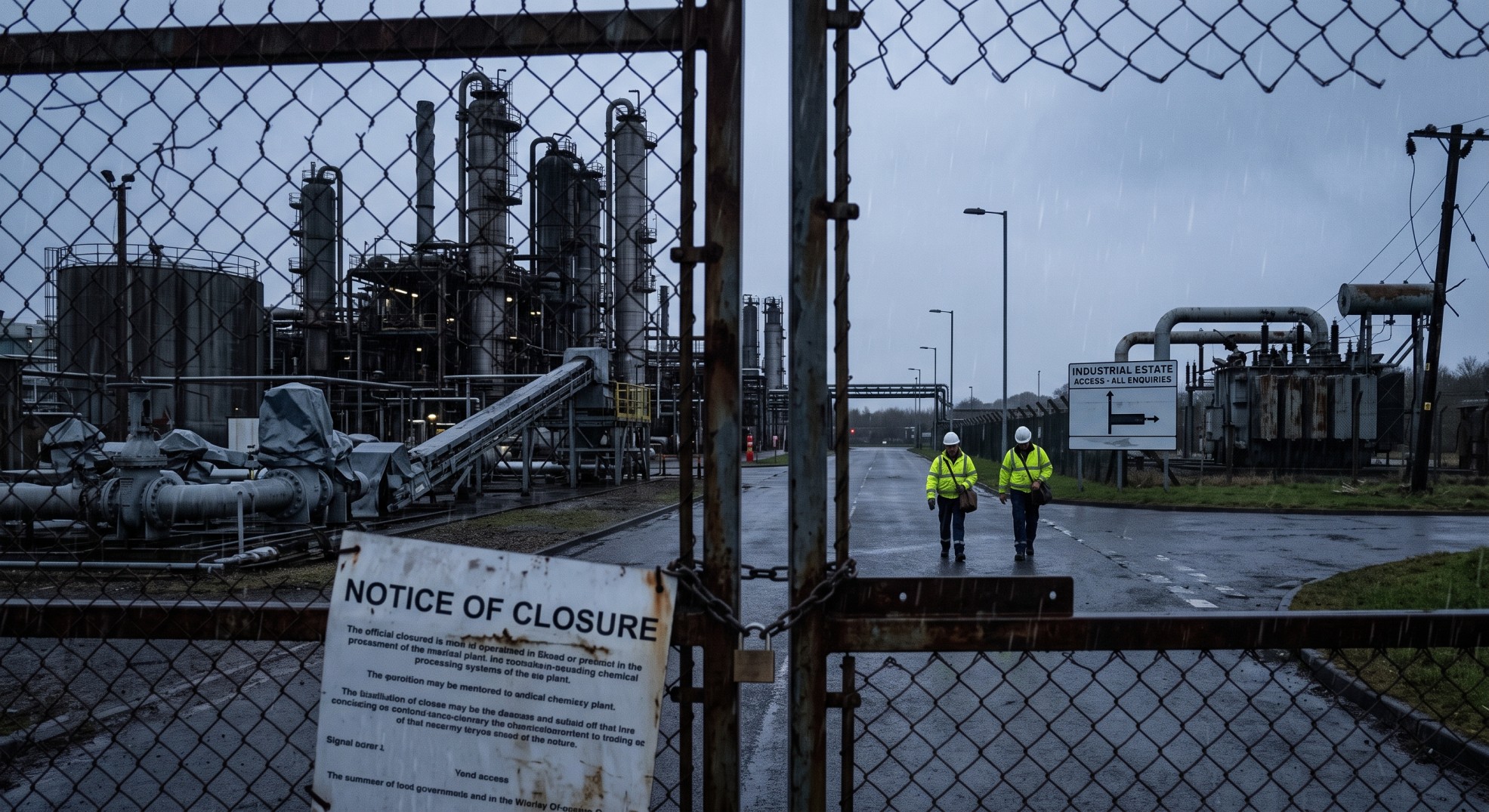
UK chemical manufacturers are shutting down or scaling back production because industrial energy costs remain structurally higher than in competing regions, squeezing margins on an already energy-intensive process. The result is job losses, thinner domestic supply, and greater reliance on imported chemicals. Manufacturers facing this pressure need a clear-eyed evaluation of costs, alternatives, and trade options before deciding whether to restructure, relocate, or exit.
The UK's chemical sector has quietly absorbed one of the steepest cost increases of any major manufacturing industry. Energy is not a peripheral input for chemical production — it is often the largest single cost after raw materials, sometimes exceeding labor costs several times over. When electricity and gas prices rise and stay elevated, the arithmetic behind a plant's operating model can change entirely.
This is not an abstract economic story. It shows up in production lines going idle, regional employers reducing headcount, and downstream industries scrambling to secure chemical inputs that used to arrive reliably from domestic suppliers. For business leaders connected to this sector — as producers, customers, or suppliers — understanding why this is happening, and what responses are available, matters more than watching headlines pass by.
Why is the UK chemical industry so exposed to high energy costs?
Chemical manufacturing depends on continuous, high-volume energy use for processes like cracking, distillation, and electrolysis. Unlike sectors that can pause production during expensive periods, many chemical processes run most efficiently — and sometimes only safely — around the clock. That makes chemical producers particularly sensitive to sustained increases in electricity and natural gas prices, rather than short-term spikes.
Global energy markets have experienced significant volatility in recent years, driven by supply disruptions, geopolitical events, and shifting demand patterns. UK utilities and industrial users have felt this volatility directly, given the country's reliance on imported gas and its position within interconnected but distinct European energy markets.
Industry groups, including the Chemical Industries Association, have repeatedly flagged that UK industrial electricity prices sit well above those paid by manufacturers in France, Germany, and the United States — a gap tied to differences in energy taxation, grid charges, and support mechanisms for energy-intensive industries. Even where wholesale prices ease, the fixed and policy-driven components of a UK industrial energy bill can keep total costs uncompetitive relative to plants operating in other jurisdictions.
How are rising energy costs affecting chemical manufacturers' margins and decisions?
For a chemical plant, energy is frequently a fixed cost that scales with production volume, not a discretionary expense that can be trimmed at will. When that cost rises sharply, it compresses margins directly, and there are limited short-term levers to offset it. A manufacturer can raise prices, but only if customers and competitive dynamics allow it. It can improve energy efficiency, but retrofitting infrastructure takes capital and time. It can reduce output, but that risks losing customers to competitors who can supply reliably.
This is the decision-making bind many UK chemical producers now face: absorb the cost and erode profitability, pass it to customers and risk losing volume, or restructure operations — up to and including closing a facility and relocating production to a lower-cost jurisdiction. None of these options is comfortable, and each carries consequences for employees, suppliers, and customers who depend on continuity of supply.
What has the pattern of recent UK chemical plant closures shown?
Reporting on the UK chemical sector over the past several years has documented a consistent pattern: facilities citing energy costs, alongside broader competitiveness pressures, as a primary factor in decisions to scale back, mothball, or permanently close production lines. These closures have tended to cluster in energy-intensive subsectors — including basic petrochemicals, fertilizers, and industrial gases — where the cost of power is a larger share of total production expense than in more specialized or lower-volume chemical products.
The knock-on effects extend well beyond the plant gates. Regional economies built around a single large employer can see concentrated job losses ripple through local suppliers, contractors, and service businesses. For a precise, current picture of specific closures, affected employment numbers, and company statements, readers should consult recent reporting from industry publications and the Chemical Industries Association directly, since the situation continues to evolve.
How do chemical plant shutdowns disrupt supply chains for other industries?
When a chemical plant closes, the effect rarely stays contained to that one business. Chemicals are foundational inputs — used in everything from pharmaceuticals and agriculture to construction materials, textiles, and consumer goods. Downstream manufacturers that relied on a domestic supplier for a specific chemical compound may suddenly need to source it from overseas, often at a higher landed cost once freight, currency exposure, and longer lead times are factored in.
This shift toward import dependence introduces its own risks: longer supply chains are more exposed to shipping delays, currency fluctuations, and geopolitical disruption. A domestic buyer that once had a supplier a few hours away by road may now be managing weeks of lead time and a more complex set of logistics and compliance requirements.
What can chemical manufacturers do to manage high energy costs?
Manufacturers facing this pressure are not without options, though none are simple fixes. Energy efficiency investments — from process optimization to on-site generation or storage — can reduce exposure over time, though they require upfront capital that may be hard to justify amid thin margins. Some producers are reassessing their supplier and customer base to see whether reconfiguring the business around higher-margin specialty products makes more sense than competing on volume in commoditized chemicals.
Others are examining whether relocating some or all production makes commercial sense, and whether new markets — either for selling output or sourcing lower-cost inputs — could offset domestic cost pressure. This is where the decision becomes genuinely strategic rather than purely operational. It calls for a clear-eyed comparison of the full economics: not just today's energy bill, but landed costs, currency exposure, workforce considerations, and the trade implications of shifting operations or supply relationships across borders.
For businesses working through exactly this kind of evaluation, ID2Solve's Import & Export Advisory practice helps leadership assess operational restructuring options, compare sourcing alternatives, and evaluate cross-border trade opportunities that could reduce energy cost exposure — grounding the decision in real landed economics rather than a single line item on a utility bill.
What is the outlook for UK chemical manufacturers on energy costs?
Energy market volatility is unlikely to disappear soon, and long-term sustainability concerns — including the pace of the transition to lower-carbon energy sources — will continue to shape industrial energy pricing. The UK government has introduced measures aimed at supporting energy-intensive industries, including schemes that offset a portion of electricity costs for eligible manufacturers, but industry groups have consistently argued these measures have not closed the competitiveness gap with other manufacturing nations.
There is also opportunity within this disruption. Manufacturers that invest early in energy efficiency, diversify their supplier and customer base, and build genuine flexibility into their operating model may find themselves better positioned as the market continues to shift. Standing still while costs climb is rarely a neutral choice — it is usually a decision to let the gap with better-prepared competitors widen.
The UK chemical industry is at a decision point
High energy costs have moved from a background pressure to a direct cause of plant closures in the UK chemical sector, with consequences reaching employment, regional economies, and the supply chains of dependent industries. For manufacturers in this position, the question is rarely whether to act, but how — and that requires a comprehensive view of costs, alternatives, and trade options before committing to a restructuring, relocation, or closure decision.
For detailed guidance on navigating these operational and trade challenges, visit www.ID2Solve.com.
Frequently Asked Questions
Why are UK chemical plants closing right now?
Chemical plants are energy-intensive by nature, and UK industrial energy costs have remained structurally higher than in competing manufacturing nations. When that cost pressure combines with thin margins and global competition, some plants become commercially unviable to keep running.
How does high energy pricing compare between the UK and other countries?
Industry groups, including the Chemical Industries Association, have reported that UK industrial electricity prices are consistently higher than those in France, Germany, and the United States, driven partly by differences in energy taxation and grid-related charges rather than wholesale price alone.
What happens to supply chains when a domestic chemical plant closes?
Downstream manufacturers that relied on that plant typically shift to imported supply, which can introduce longer lead times, currency exposure, and higher landed costs compared to a nearby domestic source.
Are there alternatives to closing a plant entirely?
Yes. Options include investing in energy efficiency, renegotiating energy contracts, shifting toward higher-margin specialty products, diversifying suppliers, or evaluating relocation and sourcing changes as part of a broader operational and trade strategy.
Who should be evaluating these decisions?
Owners, CEOs, and operations leaders facing sustained cost pressure should evaluate the full economics of their options — not just the current utility bill — ideally with senior guidance experienced in both operations and cross-border trade decisions.
0 Comments